|
(Optional) This text will appear in the inbox preview, but not the email body.
 |
 |
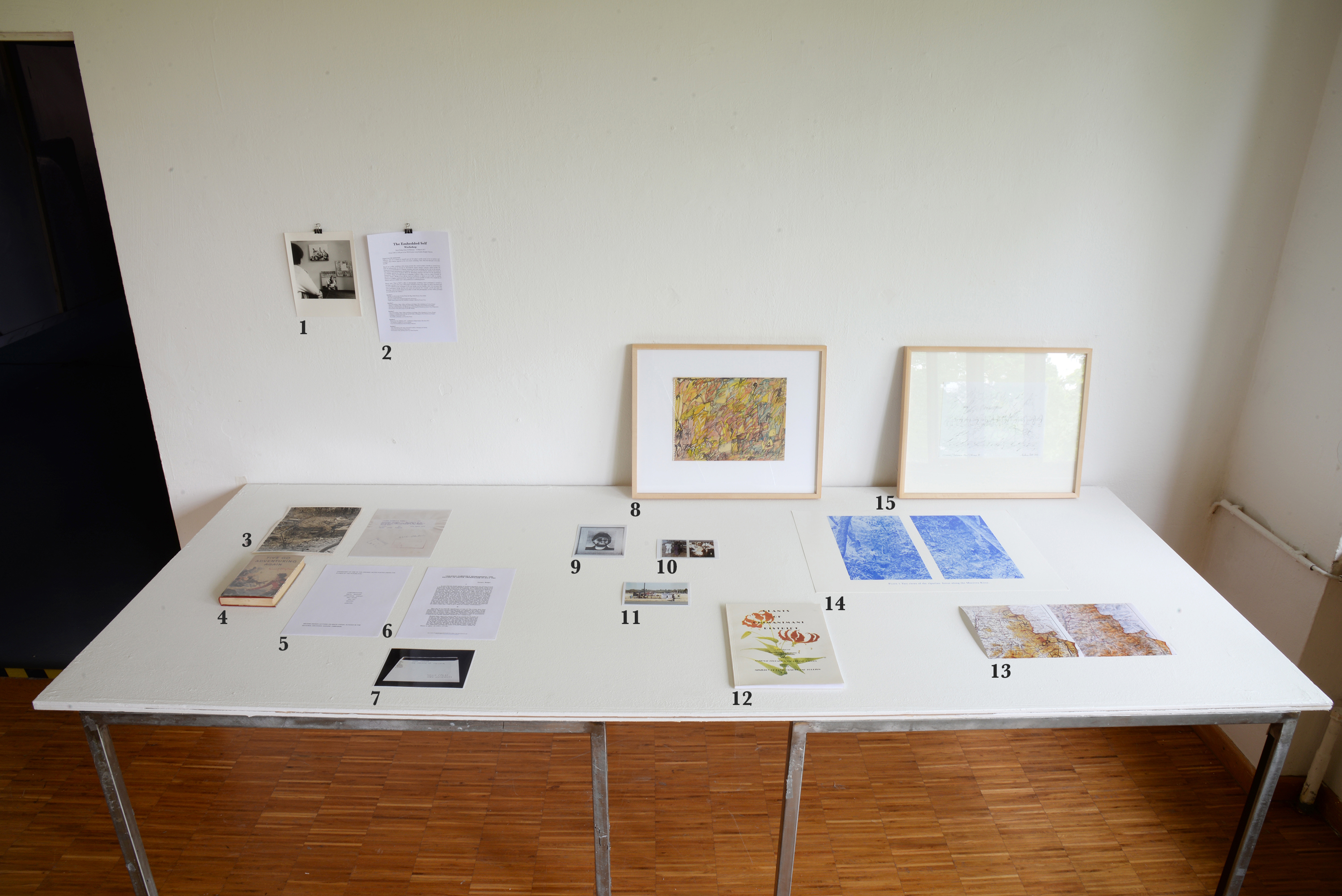
| Pasinger Fabrik, exhibition view, room #1, Library desk |
Library
|
//1// Talent Kapadza, painter from Bulawayo, participant in the workshop The Embedded Self, photo: A. Wutz. //2// The Embedded Self, description of the workshop, which was offered as part of the Echoing Silences project at the National Gallery of Zimbabwe in Bulawayo. //3// Press photo that shows a destroyed or abandoned camp of freedom fighters. Zambezi river valley, 1968. //4// Five Go Adventuring Again (1943), bestseller by the British children's book author Enid Blyton. According to a police report, the novel was found in a suitcase in a shelter in Mutare, where the Crocodile Gang had spent a few nights before their attack in Chimanimani. (see essay by T. O. Ranger). //5// Transcript of a warning of the Crocodile Gang written on a piece of paper, which according to the police report was found under stones of the roadblock built at the crime scene close to Chimanimani. Source: National Archives, Harare. //6// Essay by the historian Terence Osborne Ranger (1929-2015) on the different narratives and interpretations of the first deadly attack by the Crocodile Gang on a mountain road near Chimanimani (formerly Melsetter) on 4 July 1964 (see Library). //7// Microfilm of the dissertation The prison of colonial space: narratives of resistance by Yvonne Vera, York University, Toronto 1995. Photo: A. Wutz //8// Rashid Jogee, Untitled, Watercolor, 2017. //9// Rashid Jogee, Self Portrait, Charcoal Drawing, 1979. Photo: A. Wutz. R. J., painter from Bulawayo, was a medic of the Rhodesian army and at the same time a sympathizer of the liberation struggle. (see video hall). //10// Virginia Phiri, musician, circa 1973. V. Phiri was a member of the Liberation Army ZIPRA. (see photo and text My Objects Tells / The Copper Necklace). //11// Oliver Mtukudzi, concert announcement, Harare, 2008. (see photo and text My Objects Tells / The Record Single). //12// plants in Chimanimani district, multilingual (see photos of Invisible Landscape). //13// Map of the district of Chimanimani, Zimbabwe (formerly Melsetter, Rhodesia, right picture). //14// A botanist in the riparian forest along the Mucrera River, Chimanimani Mountains, 1972 (picture from the botanical journal Arnoldia, picture edited by A. Wutz). //15// Andreas Wutz, Ekoneni, pencil on paper, 2017. Ekoneni is the Ndebele word for 'street corner', an important meeting point in the urban environment of Bulawayo that offers space for communication, business and leisure (see Yvonne Vera's novel The Stone Virgins in the exhibition library). The drawings of the series Ekoneni translate the visual impression of different street corners in Bulawayo in visual notations.
|
| The Library includes reference material to Invisible Landscape and My Object Tells. |
|
| |
|
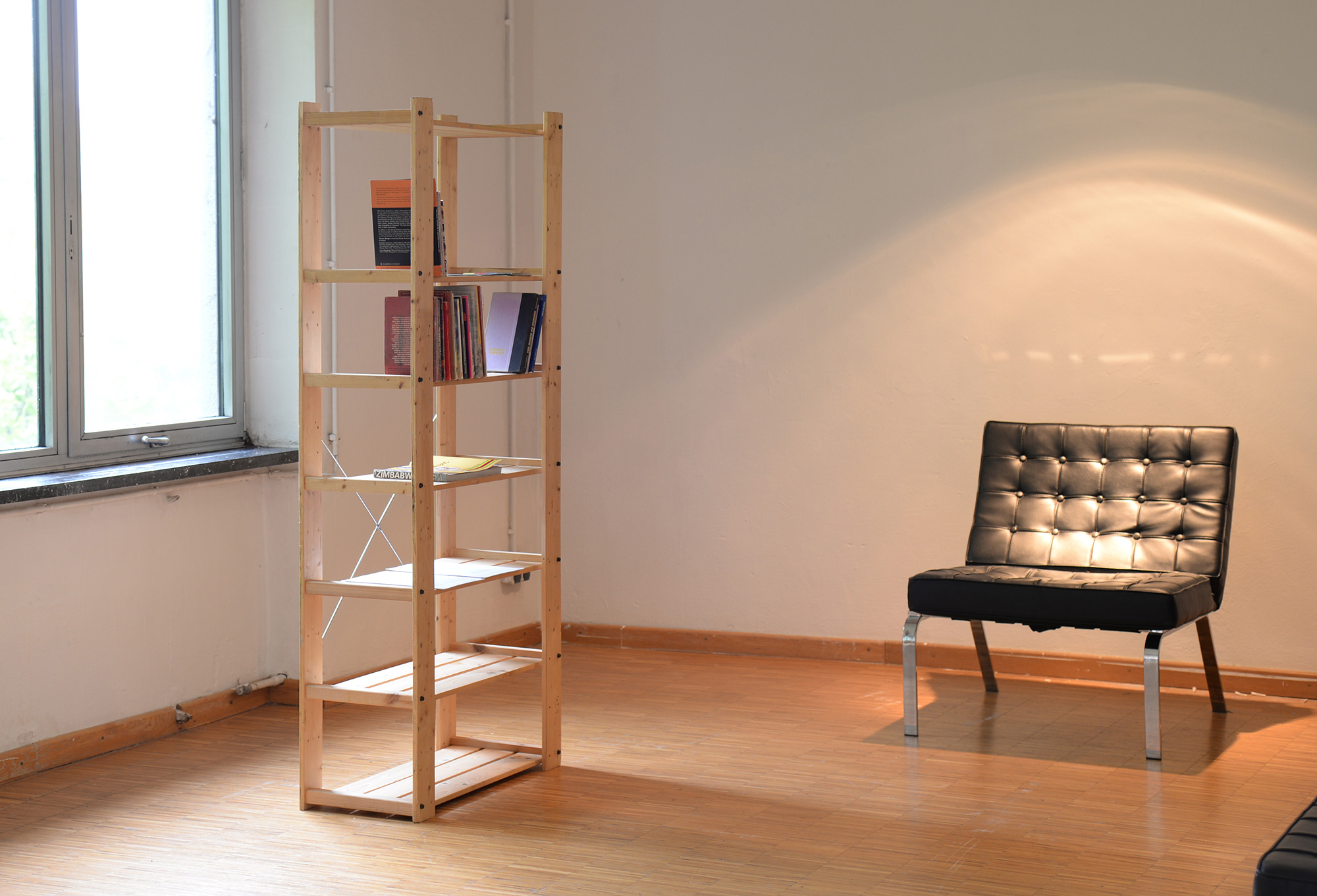 |
| Pasinger Fabrik, exhibition view, room #1, Library books |
|
|
|
| (Click on image to enlarge) |
| |
|
|